Drop down header

Saturday, 22 March 2014

Ride: Leg 2 - Ushuaia to Punta Arenas

Route summary: Ushuaia, Cape Horn, Wulaia, Magellan Island, Punta Arenas
Days: 4
Zero mileage days: 2
Distance (point to point): 249km
Distance (driven): 75km
Inefficiency factor (Driven/P2P): 0.30Avg. speed: 19km/day

Click here for detail.

On a map this looks like it should be a short leg, but I've split it out as a "leg" as it was an amazing three nights / three and a half days and although the bike was with me, she wasn't the main form of transport.

It started for two reasons. The first was that I was really keen to see more of the archipelago around Tierra del Fuego (looking at the map it looked like an amazing place to see, but almost impossible to do so other than by boat or possibly aircraft). The second reason was that I had reached the end of the road, so logic would dictate that the only exit route was back the way I'd come, and I find retracing my steps very dull. It turns out that taking a vehicle from Ushuaia to Punta Arenas wasn't as straight forward as I'd hoped, but after a few emails and some help from three different countries, it looked like I'd got it sorted [1].


I went to check in my bags and when they saw the size of the panniers they asked to have a look at the bike. It transpired that they had been expecting a bicycle with a motor and not a "moto, moto!" as Fernando kept saying over the phone. Having become excited about the trip I was now worried about it not coming off, or envisaging falling off a gangway with the bike between the ship and the dock. So it was with a sense of intrepidation that I went to the dock, passed through customs fairly seamlessly with the help of the Australis representative. Checked into my berth (very comfortable) and get a call that my bike's about to be loaded, so grab my camera and run out. They've swung a crane round and lowered a cargo net which they've laid out on the deck. Wheel the bike onto the deck and then they feed the ends through various bits of the frame, attach it to the hook and take up the tension. By this stage other members of the crew have come outside to have a look. "Have you had any other motorbikes on the ship?" I ask. "No, this is the first". Which is cool, but from my perspective nerve-wracking, although all I'm picking up from the crew is a sense of intrigue! Very quickly it's level with the top deck, 6 stories up and I have to run aboard to meet the bike up top. By the time I'm there the cargo net's been untied and I wheel it along the top deck and put it, partially under cover behind a lounge/bar area on the starboard side where he crew lash it to the side of the boat, using what appears to me to be a fairly small length of rope and a small number of knots, but they're the experts.


Then it's into the bar for a welcome drink (Pisco Calafate for me) and a safety talk before the ship departs and heads down the Beagle Channel and then we're called down for dinner. Food is amazing and we'd been told that as this was an "expedition cruise" there was no need to dress for dinner [2]. Then to the bar (it's a free bar) and take the opportunity to make a couple more entries in the "beer diary" my brother had given me before retiring to my cabin. The weather was starting to pick up and the ship was starting to roll heavily in the seas and I took the photo on the left to show the angle the ship was leaning at.


Thursday 20 March


At about 3am wake up as the boat's moving through particularly heavy seas. My mind goes to my bike and after an hour or so of this I dress and head up to find out how she's doing. Sailor's knot tying skills have apparently not diminished and she was still there and very secure, even though the wind was howling around. At 6 everyone is woken up and told to get ready for the first trip on the ribs to Cape Horn island. I was amazed they were even considering it, but after about 45 minutes the Captain made the call that it wasn't safe and the excursion was abandoned. We circled off the north east side of the island for a while and multiple photo opportunities before heading back up the way we came. Where we were the wind speed being shown on the screens charting our progress said 70 knots (80 mph / 129 km/h) or force 12 [3].


Although it was disappointing to not get onto the island, and also not to actually round the Cape [4], it was an amazing experience to be at the Cape in the sort of conditions which gave the place it's reputation. And I think that it's probably fitting. I think there would be something a little bit wrong if the least seafaring member of my family (which I have no problem admitting I am) was the first to round the Cape.


So then to breakfast, which seems emptier than supper, the night and the motion having claimed the appetite of some of those on board. Then it's a packed schedule involving a film on Shackleton's failed expedition to cross the Antarctic ice pack, but very successful recovery of the crew, lunch and a presentation on the native flora and fauna and the inhabitants whose fires gave Tierra del Fuego its name. The latter was in preparation for the afternoon's excursion to Wulaia (Yangan for beautiful bay) and a walk up hill, filled with interesting information and beautiful views (below) then torrential snow. However, at the bottom of the hill, as well as a museum, there's a trestle table set up where we were served hot chocolate, and if you felt so included, the addition of a tot of whisky. I felt so inclined, and there were some who forewent the hot chocolate.


Supper and the activities continued, including my first (and I have no doubt last) employment as a male model (for the ship's on board clothing emporium - I looked disturbingly similar to Captain Birdseye), followed by bingo and karaoke (involving a duet of an, I think, Pink song in which I was massively carried by Javiera, a member of the expedition crew).


Friday 21 March

A morning of talks on the history of the Magellan straits (a lot on glaciers and Magellan, and some about the "pirate Drake"), a lesson on knot trying (favourite was the Devils ladder) and then a presentation on Chile and all the amazing things there are to see and do in the country (including some wine tasting). Then lunch and the visit to the glacier, which is great, if damp as it rains for most of the visit. A bigger glacier than at Ushuaia and more visible. And although something apparently falls of it later, I miss it! More hot chocolate and whisky, back on the boat, hot shower, a briefing on the next morning's visit to see the penguins and supper. After supper there's an auction of a chart of the ships route to the Horn, which I bid for but don't win - probably a good idea as I'm not sure what I'd do with the large plastic chart case that it comes with. However, in the raffle, I do win the ship's ensign which had been flying up until then (and as a result was looking quite ragged)!

Saturday 22 March

An early start and for a while it looks like the weathers not going to be good enough to land (the wind has picked up again) so in the meantime everyone enjoys the most amazing sunrise. However, we get the green light and so it's off to see Magellan penguins (again), although now I have a better understanding of their behaviour after the lecture the previous day.


Then it's a short cruise south to Punta Arenas, but we don't go come into port. Apparently the winds have picked up so much that they've closed the port in the centre of town, and after being in a holding pattern off shore for a couple of hours (during which time I see the most amazing, complete rainbow I think I've ever seen), the decision is made to go to the harbour slightly out of town and land there. Even that's not straight forward though, and we need two tugs to nudge us alongside the dock. Everyone then gets off the boat, apart from me, who has to wait for the bike to be unloaded. Initially we wait for the wind to drop a bit, but then I think everyone gets a bit bored and so we do it as quickly as possible. I see it come off the top deck and by the time I'm on the dock it's down, but appears to be in one piece so I don't think it was dropped! Then the moment of truth - after 3 days of a South Atlantic salt water jet wash, does she start... first go. Customs and then a slightly unsteady ride into town (sea legs and motorbikes don't mix), for my first night on Chilean soil in this trip after an amazing three days.


Notes:

1. I'd seen on a map that there appeared to be a car ferry that went from the area to Punta Arenas (on the Magellan Straits) and another that went a lot further to Puerto Natales. However, I then found out that the ferry went from Puerto Williams, across the Beagle Channel and (importantly) in Chile (and also home to the most southerly post office in the world). There were two companies that ran boats across the Beagle Channel, between Ushuaia and Puerto Williams, but it was essentially a large rib, and so it wouldn't be possible to take my bike on it. I'd asked in some of the travel offices in Ushuaia and everyone seemed to think it was impossible. Then online I found a company that might be able to help. Wrote to Luke at Swoop Travel (based in Bristol, UK), who put me in touch with Marisol at Australis (based in Santiago, Chile) who spoke to the ship and Fernando (in Ushuaia, Argentina), who said that they should be able to get the bike on a boat (cruise ship), leaving on the Wednesday evening. It would last 3 nights and would go via Cape Horn! Although it was more money than I'd anticipated spending I went for it, on the basis that "how often are you going to get the chance to take your motorbike to Cape Horn?"
2. Which was fortunate as my black tie didn't make the cut when I was deciding it I could get away with 3 pairs of socks...
3. I know that the ship had registered winds of 130km/h at about 3am as we made our way to the Cape - it was this particularly bad weather which woke me and sent many passengers running to the heads. Cape Horn's official weather station reported winds of 40knots (a relatively tame force 8) at 6am the day we were there. Normally it also sends in a response at 9am but it didn't on that day - I like to think that's because it was too windy for the lighthouse keeper to take the reading (a family live on Cape Horn Island).
4. The route we did went out and back and didn't actually go round the Cape. As a result I can't legitimately put a gold hoop ear ring in my right ear, or put one foot on the table - privileges traditionally reserved for those who have rounded the Cape from East to West. One of the things I didn't get to see first hand, as a result of not getting onto the island, is the monument to all the sailors that have died in and around the Cape. The statue is of an albatross, turned sideways in on the wind (see below a linked image I found on the web) and a that I took picture of a bird (not an albatross I think), doing a similar thing.


Next to the statue is a poem by Sara Vial, which I think is rather beautiful and so have included below, in English as well as the original Spanish (I think the latter sounds better).


So el Albatros que te espera
en el final del mundo.
Soy el alma olvidada de los marinos muertos
que cruzaron el Cabo de Hornos
desde todos los mares de la tierra.
Pero ellos no murieron
en las furiosas olas,
hoy vuelan en mis alas,
hacia la eternidad,
en las última grieta
de los vientos antárticos.

I am the albatross who awaits you

at the end of the world.
I am the forgotten soul of the dead seamen
who sailed across Cape Horn
from all the seas of the world.
But they have not died
in the fury of the waves,
today they fly on my wings,
towards eternity,
in the last crevice
of the antarctic winds.

Wednesday, 19 March 2014

Tierra del Fuego and Ushuaia

"El fin del mundo o donde todo comienza" - "The end of the world, or where it all begins"

I've loved Tierra del Fuego and really liked Ushuaia as a city. Having learned about Magellan and Drake's circumnavigations as a 10 year old, and how they found a path through to the Pacific and then subsequently hearing people talk of Cape Horn in a tone of awe and respect, the area has had a latent sense of magic with me that I wasn't fully conscious of. However, on leaving Rio Gallegos on a very windy day, but with an enormous sense of relief that the bike was running properly again for the first time in a week, and successfully negotiating my first border crossing to get into Chile, it was amazing to get to Punta Delgado where the road runs into the Magellan Straits to wait for the ferry. The wind was incredibly strong and all there was to do was wait (I've learnt that this is the norm in Patagonia). Even the wait was an experience, chatting to other bikers, having maté for the first time, and then, as the day was coming to an end the ferries started running again. The crossing was windy and rough, but the bike stayed upright and then rode off the boat onto the land of fire. Three weeks later as I was heading in the opposite direction I saw some motorcyclists coming off the boat and could hear them whooping to themselves inside their helmets. The crossing just has that sort of effect on you.


The voiceover is: "It’s Iain, it’s Friday, I’m crossing the Magellan Straights, hopefully my bike is upright, this is awesome"

Then there are the mountains. After a couple of weeks of flatness, or very slight hills, as you leave Rio Grande you can spy ice capped mountains, although at first you might think they're clouds on the horizon. Tierra del Fuego is at the border of two plates, and the mountain range just north of Ushuaia is the border and creates the most amazing motorcycle ride up and over.


Then you have Ushuaia itself, just after the most southerly ski resort in the world. The city's not particularly attractive, but its charm lies in the fact that it feels like it's the end of the world, a real frontier town with an eclectic mix of permanent residents, new arrivals seeking a fresh start and visitors, from cruise ship passengers to cyclists and motorcylists (looking for the end of the road, either at the beginning, end or middle of their travels) to scientists on their way to the Antarctic. I spent most of the three days there walking around with a broad smile on my face, and not just because I was there for St Patrick's day.


There's a glacier 8km out from the city centre (my first in Latin America and at this stage hadn't been spoiled by Perito Moreno) with great views over the town and the Beagle Channel.


Then about 20km out of town there's a national park which is amazingly pretty, with mirror calm lakes and stunning views, and from my perspective, then end of the road (Ruta 3).


Saturday, 15 March 2014

Leg 1 - Buenos Aires to Ushuaia

Route summary: Azul, Carmen de Patagones / Condor, Las Grutas, Peninsula Valdes, Gaimon, Rada Tilly, Puerto San Julian, Rio Gallegos, San Sebastian,Ushuaia
Days: 22
Zero mileage days: 6
Distance (point to point): 2,348km
Distance (driven): 4,418km
Inefficiency factor (Driven/P2P): 1.88
Avg. speed: 201km/day

Click here for detail.
tl;dr


The first leg was as far as I'd planned a route, if "head south until you get to Ushuaia" can be called a plan or a route. On asking about roads in Buenos Aires I was warned off Route 3 (for the early section at least) as traffic is bad and there's a lot of lorries / camiones and told that the further south you go the windier it gets, until you may be physically unable to stay on the motorbike...

With this in mind, and the nagging doubt that maybe I wasn't prepared for this, I headed off at lunchtime on the Saturday of Carnaval, as partygoers started to rouse themselves for another day of bacchanalia.

The bike fully loaded on the first day
Apart from going slightly the wrong way, the first day is fairly straightforward and I arrive in the town of Azul around late afternoon. The only thing of note on the route was a diversion around an accident. However, instead of a contraflow the diversion "boxed around" the accident using dirt tracks, during which I was sandwiched between a truck in front, throwing up a huge, impenetrable dust cloud, and a car behind. Given it was the first time on the bike with weight off-road, it was an informative experience [1], and I was only disappointed none of it was on film! In Azul some very friendly people showed me where the campsite was. Got there, set up my tent, had a shower and made supper (I didn't have a gas canister for the stove so siphoned some fuel out of the petrol tank, which although messy, was a useful test of the fuel pump) and started to think that maybe I could do this after all.
Camping
At the campsite there were a number of interesting characters - another motorcyclist (I think in the Argentinian Army) enjoying the long weekend with his wife, a group of Citroen 2CV enthusiasts having an enjoyable night and some guys who were trying to find out if I was a Boca Juniors or Rio Plata fan (I'm still working out how to diplomatically say I don't like football but like rugby in spanish).


Day 2 was a straightforward run south, bypassing Bahia Blanca and trying as far as possible to stay on smaller roads before joining the 3 is unavoidable. Just south of Bahia Blanca cross the Colorado river and enter Patagonia (see right). A quick, early evening visit to Carmen de Patagones, a pretty, old town on the north side of the river, with Viedma [2] on the opposite banks, a larger, more commercial town. A very friendly security guard watched my bike while I had a look around town then went to a very dusty campsite about 20km out of town in a resort area. Not what I had planned but it's too late and too dark to argue about it now.


Day 3 was a learning day [more here], involving the bike being on its side for the first (and second) time, me using two tools I wouldn't have brought with me if it wasn't for the advice I got from Fabrice before I left, but also my first intentional piece of riding on unsealed roads, which was great fun and left me in the Argentinian seaside resort of Las Grutas where I decided I'd stay for two nights in a proper bed to recover and enjoy the last nights of Carnaval surrounded by Argentinian families on holiday.


From Las Grutas on to Puerto Madryn and Peninsula Valdez, which looks deceptively small on a map, but the isthmus is about 80km and the round trip I did the following day (to see Sea Lions, Elephant Seals and Magellan Penguins) was about 180km. On the island I met a number of lovely people, a British couple who'd hired a 4x4 and were blasting their way across Patagonia, another British couple, one of whom had been travelling on his motorbike since 2008 (he had only planned on being away for a year but since leaving the UK has travelling across Europe, Asia and the Americas and was two weeks off finishing and heading home when I met him), and an Argentinian lady who was very keen to make sure that I knew that we were friends [3].


In comparison I'm barely riding to the shops
Then from Peninsula Valdez down to Trelew and Gaiman, which were settled by the Welsh and there are still a significant number of Welsh speakers. I had a great Welsh tea - I didn't know such a thing existed - but it was the best cup - well pot - of tea I've had in Latin America, with a large plateful of different cakes and breads and jams (which I obviously finished).


Welsh Tea - Like a Devon one but without clotted cream
Gaiman and my decision to take a shortcut probably added time as the shorter route was flooded and while taking a track to box round the water feature, dropped the bike. Hot and sweaty and back on the trail, head to Punta Tombo and the largest settlement of Magellan Penguins in the world (more about penguins here).


Magellan or Patagonian penguin
Then, thinking that I can stay on the more "interesting" unpaved roads, head south to Camarones. It's about 5:30 and I'm flowing from turn to turn on gravel and packed mud. The sun is starting to go down and soften the colours of the red/brown landscape. I'm skirting the coast , with the Atlantic on my left and some slight hills and I honestly wouldn't want to be anywhere else. Somewhere I have some helmet cam footage which might give you some indication as to what it was like.

An hour later the bike's on the side of the road, in a number of pieces, having spilled about a litre of oil onto the trail from a cracked crank case and I'm wondering whether the whole adventure has come to an end less than a week before I set off from Buenos Aires [more here].
Camp, try and sleep and get up the next morning and set about getting the bike running again. Eventually get it going around 1 or 2pm (again, thanks to Fabrice) and ride (carefully) to Camarones, about 60km away, refuel (the bike and me) and then head on to Rada Tilly where I eventually find somewhere to sleep, some food and send the "I've dropped my bike" email back home...


Rada Tilly to Puerto San Julian is a cautious but straightforward run down the 3 and a night in a town where signs of the Malvinas are becoming more apparent (100m from the hotel I'm staying in - I'm spending the night in comfort as I'm feeling sorry for myself - is a fighter jet from the conflict on a plinth).


The next day on to Rio Gallegos via Santa Cruz (another smallish, windswept port). As I'm pulling into Rio Gallegos I start to get trouble with the gearbox (or caja de cambio as I now know it's called in spanish), it's sometimes sticking in some gears and can take a couple of attempts to shift up or down which I mention when I take it into a garage to be looked at the next day. The end result is that I'm in Rio Gallegos for four nights while my bike's fixed and I'm given the two teeth from one of the cogs in the gearbox that had sheared off. I don't think I could have left it any later, but am still a little proud that my roadside repairs managed to get it another 1,200km. The upside is a relatively relaxed couple of days in the windy, and although not amazing, far from charmless, city of Rio Gallegos.


This is what the wind does to clouds in Rio Gallegos
From Rio Gallegos and I get my first real experience of the Patagonian wind on the way to the border crossing into Chile and beyond that the Magellan Straits. A 4-5 hour wait for the ferry to start running (it's too windy) enjoyably spent with some LAMAs [4] on their way to a motorcycle meet in Rio Grande. Eventually get on the third ferry, have an amazing trip across the Magellan Straits onto Tierra del Fuego and have a good evening run to Cerro Sombrero where the garage is closed, but chance the extra 100km to San Sebastian and push on. Have an interesting [1] ride in the dark on unpaved roads to the border, another closed petrol station and a hotel with no rooms, so end up camping outside the petrol station, and get my first experience of how cold it can get at night.


Mountains! (After 2,500km of flat pampas it's pretty special)
Over the Garibaldi pass
The next day a fairly straightforward ride to Rio Grande, and then one of the most spectacular rides I'll ever experience to the mountains, over the Garibaldi pass and down into Ushuaia, sat on the northern bank of the Beagle Channel and surrounded by snowcapped mountains. I'd arrived at the end of the world.


Notes:
1. Euphemism for crapping myself.
2. In "Idle Days in Patagonia" by WH Hudson (I read some of it onboard a boat later in the trip) there's an interesting story of the Brazilians trying to take Carmen de Patagones in the mid Nineteenth century, where the outnumbered locals managed to successfully defend the city through various deceptions that led the Brazilians to think that the odds were against them.
3. Afterwards it occurred to me that this was a response / reaction to the Malvinas / Falklands situation. I can honestly say that, as of writing this, I have received nothing but kindness and friendliness from all the Argentinians I've met, and I hope that they would have the same experience in the UK.
4. Latin American Motorcycle Association members.

Saturday, 8 March 2014

Ride: The fall

WARNING: Contains content which mothers may find disturbing...

In hindsight it was inevitable. Bigger bike (compared to what I've previously ridden off-road), heavily laden and enthusiasm exceeding skill and experience. If it hadn't happened on that corner it would have happened on another and in many respects I'm lucky it wasn't worse. Not that this means I'm glad it happened.


Friday 5th March, 2014


It had been an awesome day. Lots of penguins at Punto Tombo and I was getting (over) confident on the gravel roads that I was travelling on. But I was having a lot of fun. [4].


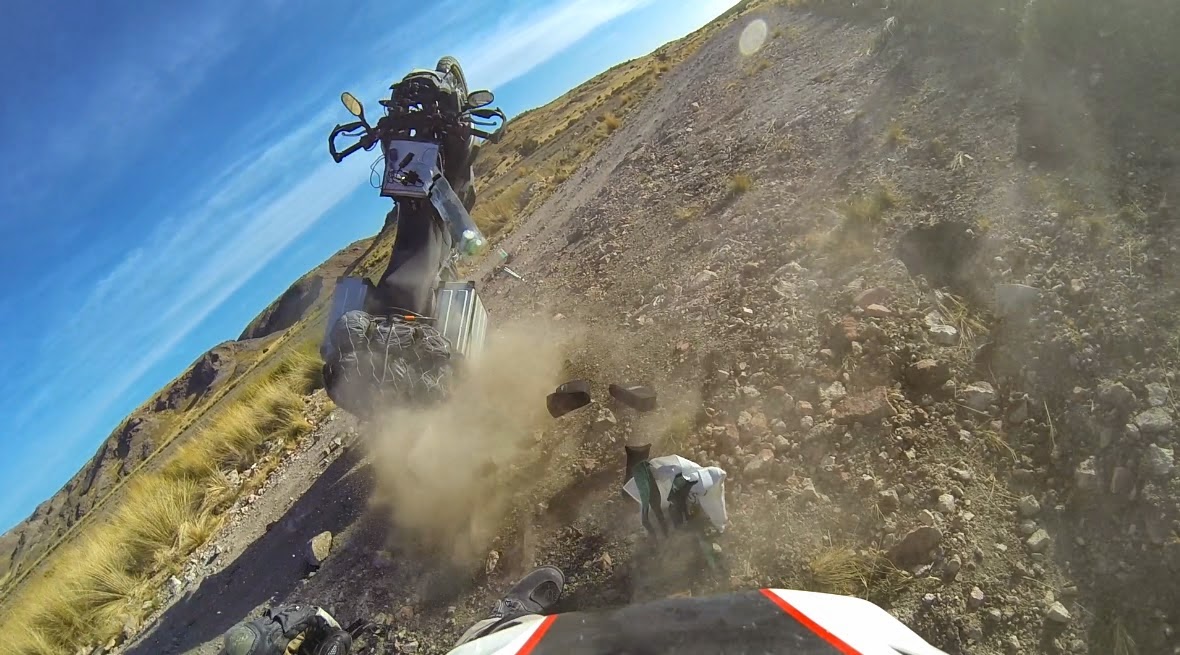
I had actually been thinking that even though it was a Friday at 6pm, there wasn't anywhere I would rather be (i.e. a pub). Half an hour later that would all change. I went over a slight rise, the road went down and then bent to the right and split. I thought that the track on the left wasn't a track and tried to keep right (and on my side of the road) but didn't make the corner and went into some rough ground in between the two tracks. The front wheel hit a boulder, throwing me off and sending the bike end-over-end down the track, coming to rest on its side.


Not a view you ever want to see

I got up (good first start), lifted the bike up and then went about collecting the bits of bike that had come off (screen, mirror) and the contents of my tank bag which had exploded, scattering books and cables across the trail.


Then it was a case of assessing the immediate damage:
  • Leaking oil, not sure about other fluids (i.e. primarily worried about petrol, but also water). It looked to be out of the bottom of the engine case but the skid plate (now very buckled) was in the way, so I'd have to take that off before I can work out what's happened.
  • Right foot-peg bent.
  • Various "cosmetic" damage (screen, wing mirror etc).
  • Left pannier mechanism not working.

So I take off the skid plate and find that the crash protection on the right hand side had bent such that it had deformed the cover plate of the crank case, breaking through the seal and letting oil leak out. The question was whether to glue it and hope to stem the flow of oil, or whether this would make it impossible to do a longer term repair. However, if I didn't glue it, how would I get it to a garage to make a longer term repair? I also didn't know what internal damage might have been caused as a result of the deformation of the crank casing, or could be caused if I tried riding the bike with it in its current condition. And I didn't know whether the bike would start if I managed to fix the leaks.

Put the tent up (I'm definitely here for the night and it's getting dark), move everything off the road and get into my sleeping bag to have a think about what to do in the morning, in the full awareness that the adrenaline would have worn off by then and I'd likely feel rubbish. No food. I'm not sure if any fuel has leaked out and getting to Camarones (where the next petrol station is) was going to be tight as it was, so don't want to siphon any out of the tank, and also don't want to use more water than I need to, not knowing how long it's going to take to get the bike going, or if not, when the next vehicle is going to come down the road (there hasn't been a car since I came off). Get the sat phone out and check it works.

I'm relatively unscathed. My right wrist hurts but I don't think I've broken anything [1], and although weaker is usable (I take some ibuprofen to take the edge off and to help me sleep) and have some small grazes. I'm glad I'm wearing the kit I am [2].


Try and sleep (the wind picks up making this difficult) and mull over my options for the next day - keeping my fingers crossed that the bike (now having become a "she") will be going come tomorrow night. The thing that haunts me is that although I have a plan, if it doesn't work, and I can't start the bike, then the whole adventure may have come to an ignoble and expensive end on an anonymous stretch of road, less than a week after I started. Even El Poderoso 2 lasted longer than that...


Saturday 6th March 2014


Alarm goes off at 6 but only really get going at 7. Decide against calling anyone in the UK. They wouldn't be able to do anything to help and all I'd be doing would be worrying people, potentially unnecessarily. Overnight I've resolved to glue the gap using the liquid metal Araldite that Fabrice recommended I take [3]. I lay the bike on its side and clean the area as best I can and then try and fill the gaps around the bolt that's been pushed into the casing. It takes an hour to set and four to set hard, so after an hour I put the bike upright (I'm still concerned about losing fuel) and after three hours try putting some oil in (using a plastic bag as an improvised funnel) and check for leaks. It looks okay. After four hours top up and try the engine. It starts (hurray!) but there's a slight leak, so stop the engine and use more glue to try and stop where I think the leak is coming from. Two hours later try again and, although there seems to be a very slight weeping of oil, it seems to be holding.


How to top up the oil with no funnel. Surprisingly effective! 

In the intervening time I've had a go at some of the other bits. Bending the foot-peg back into place as best I can, gaffer taping the wing mirror back on and dismantling the left hand pannier to get the unlocking mechanism to work again (one of the metal levers had been bent out of place).

Then load the bike up (now with the skid plate and screen strapped on top of the tail bag) at which point she promptly falls over (my fault for not loading her up on level ground). Unpack, lift up and load again and tentatively head on to Camarones 60km away, all on ripio.


It's about 3pm by now. In the 21 hours between coming off the bike and heading on I've seen three vehicles, the first being at 1030 this morning.


Arrive at Camarones, refuel the bike, check for oil leaks (none - phew) and refuel myself (three litres of fluids and food). The bike seems to be be holding together, although the front fairing of the bike has been bent back which is throwing the headlight up significantly. Night riding won't be possible for a while. Tarmac now back to Ruta 3 and then south through Comodoro Rivadavia where I happen to pass a Yamaha service centre. The only thing is tomorrow is a Sunday and I don't want to hang around for another day to see if they can help, so carry on to Rata Tilly and check into a motel for the night.

Rio Gallegos is the next decent sized town on the way down and the bike holds up until then, although as I pull into the city the gearbox starts to stick. I take it in to be fixed at SM Motos and I think probably just in time.


And the experience has made me a less exuberant rider but also gave me more confident that I could cope with most things that the trip was likely to throw at me.


NOTES:

1. I've broken the scaphoid in my left wrist twice, the second time I didn't realise it was broken for about seven months, at which point it needed surgery to be rejoined. I'd rather not have a matching scar on my right wrist!
2. Some people have likened me to an astronaut with my kit, I think it's primarily because of the Leatt neck brace that I've got. However, I'm glad I've got it. I was in a car park on Peninsula Valdes when a guy pulled up in a car next to me. He pointed at the neck brace, which was hanging off a wing mirror at the time and said that they were a good bit of kit and had saved his life. I thought that it was just a saying until he pointed out that he was parked in the disabled spot, told me he'd had a motocross accident and had broken his back in three places, and proceeded to get a wheelchair out from where the passenger seat would be to join his son in the museum.
3. Memo to self - drop off multiple cases of beer to Fabrice next time you're in London.
4. This video doesn't actually have the crash in it. Sorry to disappoint those wanting a bit of "You've been framed" style entertainment. I do have it on video, I'm just not ready to share it...

Monday, 3 March 2014

Ride: Day 3 - "Adventure Motorcycle school for beginners"

.. Days 1 and 2 passed without incident, in that I didn't get too lost, found somewhere to sleep and although I went off road for the first time (police diversion around an accident), I managed to stay upright although at some points the was some swearing going on inside the helmet (largely down to the fact that I was sandwiched between a trick and a car and couldn't really see where the road was).

But people generally aren't interested in when things go to plan, which brings me to Monday. The day started badly with a cold shower, worsened when I realised I needed to unpack the bike to get the GPS coordinates for the day just after I'd finished securing everything and then on the road realised that I needed to turn around because the closest petrol station was behind me and I didn't have enough fuel to get to the next one.

It was on the way back that the first thing happened. I stopped to plug the remote for my helmet camera in to charge -  it runs off the bike's battery - as I wasn't going to need it any more. It took longer than anticipated and at some point I must have switched on my fog lamps as when I came to switch on the engine there wasn't enough battery power [1]. Step off the bike,  slip and drop the bike into the road. A small amount of swearing (given the circumstances) and then lift the bike upright again [2].

When it's up I notice the left pannier has popped out of the mount on the bottom and won't open. So take off the top bags and take out my breaker bar (2) and use this to lever it back on, which it did with a satisfying pop. Then open up a pannier and take out the solar charger I have [2] and connected it to the battery. Then packed everything else up and loaded it back onto the bike again and waited. Fortunately it was a sunny day [3] and it charged quickly and, with fingers crossed) the engine started and got me back to the petrol station.

By that stage it was getting on in the day and my plan of getting to Trelew was out of the window. Las Grutas was the next stop, which wasn't far and so gave me the opportunity to take some of the (unsurfaced coast road). First attempt to get to it ended in a locked gate and a water crossing so headed back to the 3. Second attempt got me on my way and after about 45 minutes realised I'd gone a couple of hundred meters past the turn I needed.  Came to do a U-turn and the bike went into soft sand/dust on the side of the road. Front wheel got out but the back wheel got stuck and then bogged in. So get of the bike (it stays upright without the side stand), unload everything and then lift the back wheel out but end up having to lower the bike to get the wheel out, then have to lift the bike with my feet slipping in the sand to get it upright again [1]. Check everything's working then load everything up again and head off.


And then have the most amazing ride on gravel and sand along the most spectacular coastline you can imagine, culminating in arriving in Las Grutas (a coastal resort) as the last embers of the day are fading in the sky.


The mileage wasn't massive [4] but I feel I earned them, and the cold beer and paella when I arrived.

In hindsight, it was all very tame. The first incident happened on a tarmac road, and although there wasn't much traffic I think you'd only need to wait 10 minutes for a car to come along and I wasn't more than 15-20km away from somewhere. The second would have been more slightly more challenging but the bike was always fine. The problems I faced at the end of the week had the much more potential to be terminal, but at this stage I was blissfully unaware of that.

BTW -  first proper [5] beer since arriving. Given its brewed about 50km north of Buenos Aires I've seen it more here - obviously a good sales guy...


Notes:
1. It has occurred to me subsequently that the battery was fine and it was the ignition switching (depending on how you shut the engine off  - i.e. with the key or the shut-off switch - the requirement for it to be in neutral is different) but I'm pretty sure I'd worked though all the combinations before getting (falling) off the bike.
3. Although it meant the battery charged quicker, it made me realise that my camel back is relatively small and that I hadn't refilled it (or the litre of water in the tail bag), which was seeming increasingly foolish.
4. 380km, compared to 378km on day 1 and 699km on day 2. See route maps / log for more.
5. Isenbeck, brewed by Cerveceria Argentina, just south of the border with Uruguay and part of SABMiller. It's an all malt brew (Quilmes, the leading local brand is also brewed with an adjunct, I think Maize) and, unbiased as I am, prefer it to Quilmes!

Thursday, 27 February 2014

History - Buenos Aires and the British

I saw something unusual today [2]. In the back of Santa Domingo Church and Convent on the corner of Defensa and Av. Belgrano are five flags. I think two are Argentinian standards, but the other three are from units of the British armed forces. They date back from 1806 when the British made the first of two abortive attempts to take Buenos Aires. Despite studying the period for A Level History this was the first I'd heard of it [1]. The plaques next to two of the colours said they were for 1st and 2nd Battalion 71st Regiment, which a bit of wikipedia tells me now lies within 2 SCOTS after the various amalgamations. The third claims to be Royal Marines although it appears to be disputed as to whether they are true colours. Given the importance of the colours to a regiment and the lengths they'll go to to not lose them (or failing that, get them back) seeing two or possibly three on public display surely has to be fairly rare.


Colours of the 1st Battalion 71st Regiment
Plaque reads: "Trofeo de la reconquista de Buenos Aires. 1806. Del Primer Batallon del Regimiento 71"

Apparently the British Army spent some of their time (while trying to take the city) in an area around Retiro in and around what is now Plaza San Martin. This later became a training ground for the Argentinian army and part of the park is now home to a memorial for the 649 Argentinians that died during the Falklands War.

Memorial in Plaza San Martin 

In the centre of the city, near to the Presidential Offices in the Casa Rosa, veterans of the Falklands conflict have been camped out in the square for years (probably decades) protesting for greater benefits for those affected by the war. I think it's telling that in the UK a similar thing is also taking place with the South Atlantic Medal Association campaigning to maintain support for UK veterans (some of whom are still struggling to come to terms with their experiences) and the (at least) 95 for whom it was too much and committed suicide.

I wonder whether in thirty years time we're going to see the same thing with veterans of Iraq and Afghanistan, long after it's the done thing to wear a Help for Heroes wristband?

Notes:
1. I can still remember learning about Nelson's victory in Trafalgar in 1805, bits about the Peninsula war, the introduction of Income Tax as a temporary measure by Pitt the Younger, but maybe my lack of knowledge of anything that took part in the southern hemisphere is why I got a B...
2. Update 16/4/14: It's been pointed out that there's a lot of stuff about flags here. Any similarity with Sheldon Cooper's "Fun with Flags" is purely coincidental...

Wednesday, 26 February 2014

La Ruta

The route is uncertain. Primarily because all of the elements in the "distance-speed-time" triangle are currently uncertain. I don't know how fast I'll travel (or how far I can cover in a day), I don't know for sure how many days I have [1] and so I don't know where I'll end up (or where I need to end up).

Attached below is a very neat drawing of the planned route, as interpreted by my 4 year old niece. Start in Buenos Aires (arriving by plane, although I can't recall if it was blue as drawn). Then on my black motorbike I'll head south through Argentina to Patagonia and the penguins, before coming back north, onto the west side of the Andes up to around Colombia, seeing guinea pigs en route.

2014 Road Trip by Izzy

Some of the things I would like to see / do on the way [2]:
  • Learn Spanish (so a couple of longer stays in interesting places to have a language course and practice in between, like Valparaiso);
  • See Patagonia, the penguins and the glaciers (and I think whales on the way down and back). Antarctica would be cool but I doubt I'll make it this time;
  • Go to the Altaplano and salt flats;
  • Visit the wine regions;
  • Climb Macchu Picchu;
  • Visit the Galapagos and in doing so sail across the equator;
  • Drop in on a few breweries and sample the product.

Notes:
1. This depends on two things: work and the all important "savings-burn rate-time" triangle.
2. Not comprehensive and open to suggestions/recommendations as long as they're reasonable and timely (i.e. don't tell me that I "must go to somewhere in Argentina" when I'm in  Peru...).

Bike/Kit: Introducing The Bike

The Bike, gender currently tbc (1), is a Yamaha XT660Z Tenere.

I chose the Tenere because I didn't want / couldn't justify the price of a BMW, didn't trust the reliability of the Ducati (speaking from experience - the other woman in my life is a 748) or the Triumph and couldn't find an equivalent Honda or Suzuki. Although I like the idea of a KTM I didn't want to have to get a bigger bike - I went for the 660 over the 1200 Super Tenere as I'm not sure I could see the benefit in a bigger, heavier (therefore thirstier and harder to pick up) bike. That makes it sound like it was a process of elimination rather than a positive choice but (so far) I'm a big fan of the Tenere. The tank is big and it's relatively frugal so has good range. Once you swing your leg over it (it's quite tall), it's comfortable to ride and nicely balanced seated or stood. The 660 engine, although not going to win many drag races, is known for being bomb proof, and (apparently) has a low compression ratio which means it will cope better with poor quality fuel (which might be more likely in some of the places I'm going to). That's not to say that the other's aren't legitimate choices - that's not an argument I want to get into!

The bike at Dover about to make its first foreign foray

It came fitted with the "Adventure" kit which comprises panniers, hand guards, main stand and tank pad. I've made a couple of alterations / additions to this:
  • Crash plate (Adventure spec) - this appeared to offer more side protection than the Yamaha or Touratech ones although there is some vibration;
  • Heated grips (Oxford);
  • Headlight protector (Yamaha);
  • Fog lamps - left and right (Touratech);
  • Auxiliary power socket (Touratech);
  • Camel toe (Touratech);
  • Radiator grill (Metal Mule);
  • Brake fluid reservoir protector (Touratech);
  • Works footpegs (Touratech);
  • Screen spoiler (Touratech);
  • Rectifier cover (Touratech);
  • RAM bracket for GPS (RAM mount UK);
  • Scottoiler vSystem with Dual injector (Scottoiler);
  • Zega Pro topcase rack (Touratech) - because I wanted to future proof it so I can use one of these...;
  • Input for Oxford Solariser, solar battery charger.

In terms of luggage I have:
  • 2 x panniers (22ltr each, Yamaha);
  • 1 x tail bag (40ltr Wolfman Expedition dry duffel);
  • 1 x tank bag (12 ltr - claimed, Touratech);
  • 1 x handle bar bag (Touratech).

This seems like a lot but once you include tools, spares, paperwork and camping equipment there's not a lot left for luxuries like spare socks!


A profile view, not far from Ghent in Belgium

Notes
1. I'm not sure if it'll be the stalwart male companion that digs me out of a hole or the female love that I occasionally have a shouting match with but would go to the end of the world for.

What's in a name...

Basically all the good, easy to remember URLs had gone, so I went with this one - "un diario de la motocicleta" (without the spaces), which Google translate (I didn't trust my Spanish at the time) told me was "A motorcycle diary". The reason for calling it this is because:
  • It references "The motorcycle diaries" or "Diarios de motocicleta", the story of Ernesto "Che" Guevara, Alberto Granado and their single cylinder Norton 500 bike's eye-opening journey from Buenos Aires to Venezuela, although I seem to recall that the bike didn't make it to the end. I'm starting in a similar place, following a similar route and also riding a big, single cylinder bike. I think the similarities are likely to end there, I'm the other side of 30, am not a medical student hoping to work in a leper colony and don't have ambitions to appear on the walls or T-shirts of (potentially misguided) students. I also don't suggest that I'm the first person to have done this since - hence the use of the indefinite article. (1)
  • The title is in Spanish, or at least Spanglish, which is one of the reasons why I'm doing the trip. As such it would be very ironic if it was wrong...
  • It will be partly a diary and partly about motorbikes and occasionally (potentially frequently) neither of these things.
  • It demonstrates I have a tendency to overthink things, and I'm afraid 8 hours in the saddle looking at the pampas, probably isn't going to help this.
Iain

26/02/2014
Buenos Aires (S: 34° 37.183' W: 58° 23.307')

Post-script (17/4/2014)

Before I left some people had said about the trip - "you could write a book about that". However, this is not a first step at publication, basically because it doesn't meet the criteria necessary for publication (and in some respects I hope it doesn't as that likely means something has gone badly wrong). The more time I spend here the more I realise that there are a lot more people doing this sort of trip than you might think. So, to make a book worth reading (and therefore worth publishing), it needs to be one (or ideally more than one) of the following:
  • written by someone famous. Either before the trip (e.g. Ewen McGregor and Charlie Boorman) or afterwards (e.g. Che Guevara);
  • written by a talented writer / journalist (e.g. Eric Newby);
  • be the first, or longer, or harder (e.g. Ted Simon's Jupiter's Travels) - I've met a motorcyclist who left the UK 6 years ago, cyclists who have spent 2 and a half years cycling the length of the Americas and ridden past someone walking north on the Carratera Austral pulling a trailer heading god knows where. My couple of month bimble round bits of Latin America doesn't really cut it from this perspective;
  • have a natural narrative arc, usually involving a crisis of some kind (e.g. 127 hours - I'd rather not have an experience like this, although I do have a sharper knife!).
Or you can make it up (e.g. Shantaram), but that seems rather pointless.

Notes:

1. When I wrote this I hadn't actually read it, I have now. It's a very well written book and he comes across as a pretty mature person apart from the last couple of paragraphs, but that could well have been written at a later stage (the last part of the book is much more fragmented and significantly less coherent than the rest of the book). There's also no reference to his trip to the USA which he did between leaving Venezuela and returning to Buenos Aires. I'd have been interested to see what his perspective of the USA was and the people he met there, or whether he was as prejudiced as he claimed visitors in the opposite direction were.